System Upgrade Program – 2026 Update
System Sustainability and Reliability: Infrastructure Improvements Summary
Since 2018, G.L.D.C. has advanced a structured program to renew aging distribution infrastructure, strengthen system reliability, and expand capacity to meet rising demand. Through self-construction, targeted looping, and modernization of key tap facilities, we have improved operational responsiveness while reducing environmental risk. From January 2018 to January 2026, total system improvement spending was $4.5 million, with provincial grants supporting more than 42% of this investment (including estimated 2025 grant funding).
In response to aging infrastructure across our distribution system, the Board and Management established a 10-year Strategic Plan in 2018. The plan set out a prioritized program to renew end-of-life assets, improve system reliability, and increase pipe capacity where needed. Pipeline upgrades began in the spring of 2019.
Our long-standing gas balancing program helps pinpoint areas where leaks, pressure losses, or failures may be occurring. Through this monitoring, we identified a clear trend: as sections of pipe exceeded 50 years of service life, leak frequency increased and delivery pressures declined.
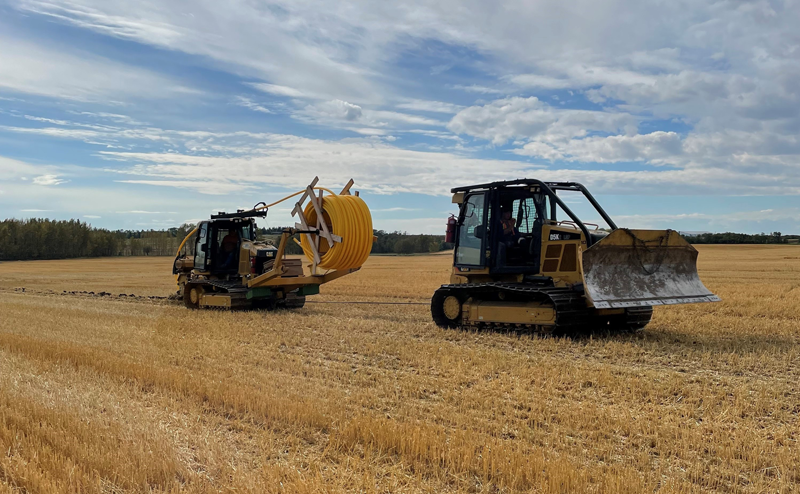
Management, working with our Auditor, developed and presented the Board with a system upgrade business case that compared third-party installation costs to the cost of purchasing equipment and hiring staff to complete more work through self-construction. After reviewing the analysis, the Board and Management concluded that greater ownership and control justified the investment. To balance cash flow, we financed certain equipment purchases; this required major equipment to be purchased new to meet lending requirements.
From the outset, self-construction delivered measurable benefits. Based on our projections, the equipment would pay for itself within the first five years of the 10-year plan. After acquiring the required equipment, we hired one full-time and one part-time employee to complete the work. With equipment available year-round, we improved scheduling flexibility and significantly shortened response times during emergencies.
In 2019, we began a replacement program for our RMO (Regulating, Monitoring, and Odorization) facilities—sites where we purchase natural gas from the TransCanada Pipeline system. We replaced Tap 30 (Aspelund Road) with a new facility designed to reduce fugitive emissions, including updated overpressure protection that no longer vents gas to the atmosphere.
We also acquired the Tap 200 facility and a communal farm it services when the existing system was no longer viable for the group to operate independently. The RMO was brought up to code for temporary service, and a new distribution pipeline was installed to meet the required demand.
In 2020, we completed the Tap 200 commitment by replacing the temporary RMO with a properly sized and equipped facility. We also continued upgrades at Tap 30. This was our first full construction season using the new equipment, and we installed 9 km of replacement pipeline.
In February 2021, we experienced an extended period of peak load. System end pressures showed that certain pipelines were approaching—and in some cases exceeding—their ability to deliver gas reliably to consumers. In response, we prioritized looping projects to increase downstream capacity at key taps. With applications for three large grain-dryer services and emergent loop lines, our construction program more than doubled compared to prior years, combining self-construction with third-party support. In total, more than 40 km of pipe was installed through new infills and looping. We also upgraded Tap 20 (RMO) and modernized the secondary regulating station in Gull Lake serving both urban and rural members.
As operational and regulatory requirements expanded, we grew our administrative team and quickly outgrew our office space. In 2021, plans were finalized and funding was approved to construct a 3,400 sq. ft. addition using proceeds from the sale of CCI Wireless. The addition includes a Training Center for in-house training and Board meetings. Construction began in spring 2022 and was completed in spring 2023.
Remember most of 2020 and 2021 provided the additional challenges of the Covid-19 Pandemic. Learning to meet virtually was a challenge for staff and directors.
In 2022, we completed 7.5 km of pipeline upgrades on Taps 20 and 90. At Westlake Road, we consolidated two co-located RMO stations (Taps 50 and 230) into a single high-capacity facility serving both distribution sectors. This approach reduced capital costs and lowered ongoing operating expenses compared to upgrading two undersized sites.
In 2023, our self-construction results increased significantly. New services required 16 km of pipe and legacy pipe upgrades required 11 km. Monitoring also identified locations where delivered volumes had increased beyond original design capacity; to address this, we installed an additional 13 km through looping and re-routed lines. In total, 41 km of new pipe was installed. Above-ground upgrades included modernizing a secondary regulating station to support increased demand near the north side of Sylvan Lake.
In 2024, we received applications for increased delivery volumes and new high-volume agricultural loads. To maintain reliable service, we completed extensive looping on multiple taps and continued planned pipeline upgrades on Taps 20 and 30. We also upgraded and replaced Taps 10 and 130 to support ongoing membership growth. This marked our highest year of investment in system improvements since the 10-year plan was implemented.
In 2025, our upgrade activities returned to previous levels, in part due to the recycling of the former Tap 130 building and associated piping. We refurbished the equipment and modernized regulators for use at Tap 220, resulting in significant savings compared to new fabrication.
These investments strengthen system sustainability and reliability while supporting rising demand and continued membership growth.
Respectfully submitted,
Board and Management, G.L.D.C. Gas Co-op Ltd.